How to Choose the Right Concrete Finish for Fall/Winter (and Avoid Slips When It Snows)
When temperatures drop, surfaces get wet, refreeze, and see more grit and de-icers. That combination magnifies two risks: slipping and surface damage. The “right” finish balances traction, durability in freeze–thaw, cleanability, and maintenance.
At Brosco Concrete, we help homeowners and businesses balance slip resistance, durability, and design year-round.
Below is a practical framework grounded in standards and technical literature—plus clear specs you can lift into your jobs.
1. Start with the substrate: durability beats everything
Even the grippiest finish fails early if the concrete can’t handle winter. For exterior flatwork exposed to de-icers and freeze–thaw:
- Air entrainment & low w/cm. Use a properly air-entrained mix and low water-cement ratio; this dramatically improves resistance to scaling from de-icers and freeze–thaw cycles
- Strength & curing. ACI/industry guidance ties better scaling resistance to adequate strength and proper curing; 3500–4000 psi is commonly cited in practice for slabs exposed to de-icers. Avoid de-icers the first winter, and cure thoroughly.
Why this matters for finish choice: Finishes with micro-texture (broomed, light exposed) keep traction, but they rely on a sound top layer. Overfinishing (e.g., hard steel trowel) can locally reduce entrained air at the surface and raise scaling risk.
2. Pick a finish by use-case (traction vs. cleanability)
Sidewalks, walkways, driveways (general exterior)
For homeowners, choosing the right residential concrete finishing services can make all the difference in winter traction and durability.
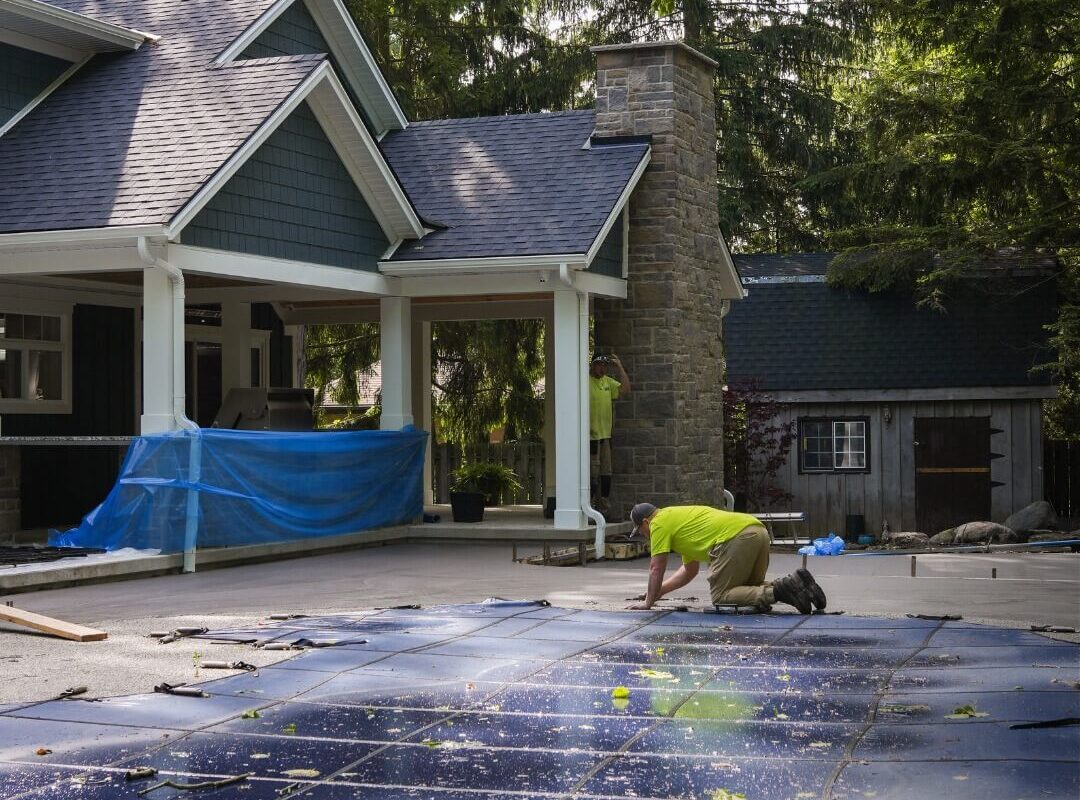
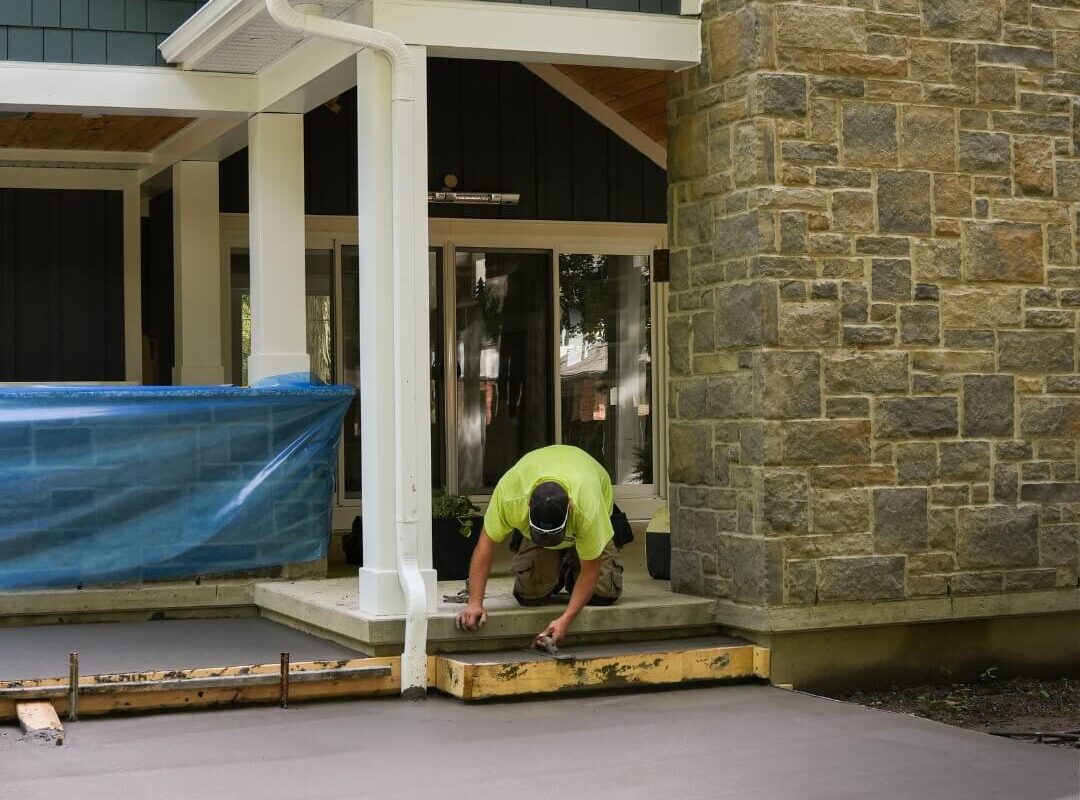
- Recommended: Medium broom finish (uniform, fine to medium striations ~1/16–1/8 in. deep). Pull the broom perpendicular to the line of travel for best foothold; on sloped surfaces, run marks toward drains to aid water shedding.
- Why: Brooming is the most common way to create a slip-resistant exterior surface; it outperforms troweled finishes when wet.
Ramps, steeper slopes, loading areas
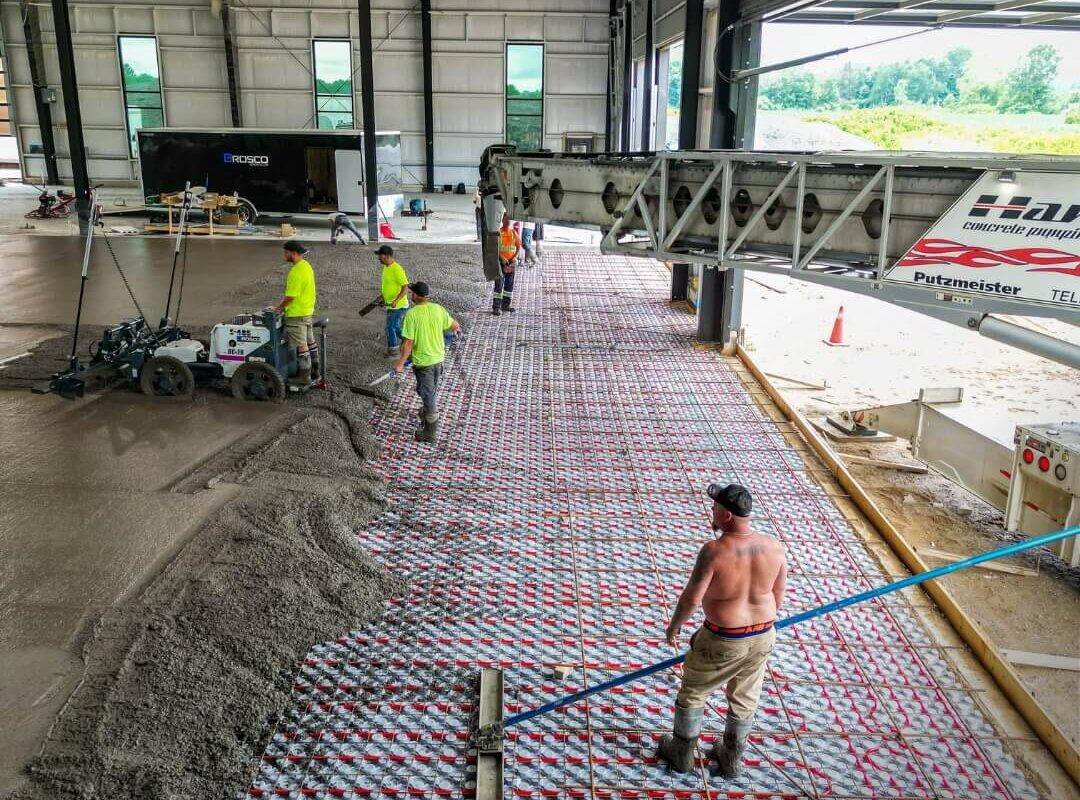
For businesses, investing in commercial concrete finishing solutions ensures safer ramps, loading areas, and public-facing surfaces during icy conditions.
- Recommended: Coarser broom or light tining/grooving for higher macrotexture. (Grooves increase directional traction on grades.)
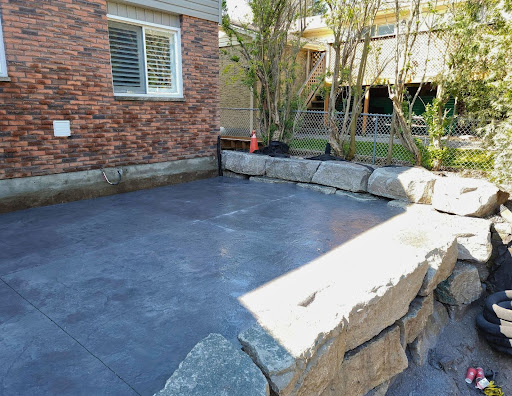
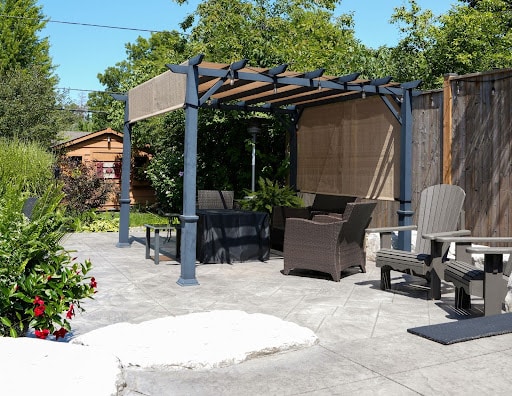
Decorative/stamped concrete (public-facing areas)
Stamped finishes are evolving quickly, see the latest concrete patio trends for 2025 for designs that balance safety with style.
- Recommended: Use non-slip texture skins and seal with a penetrating water repellent or a film-forming sealer plus anti-slip grit in the final coat. Film-forming acrylics can get slippery when wet if used alone.
If you’re deciding between ornament and traction, check out stamped vs traditional concrete driveways in London, Ontario to understand how each finish performs in snow, ice, and wear.
Pool decks/entries with frequent wetting
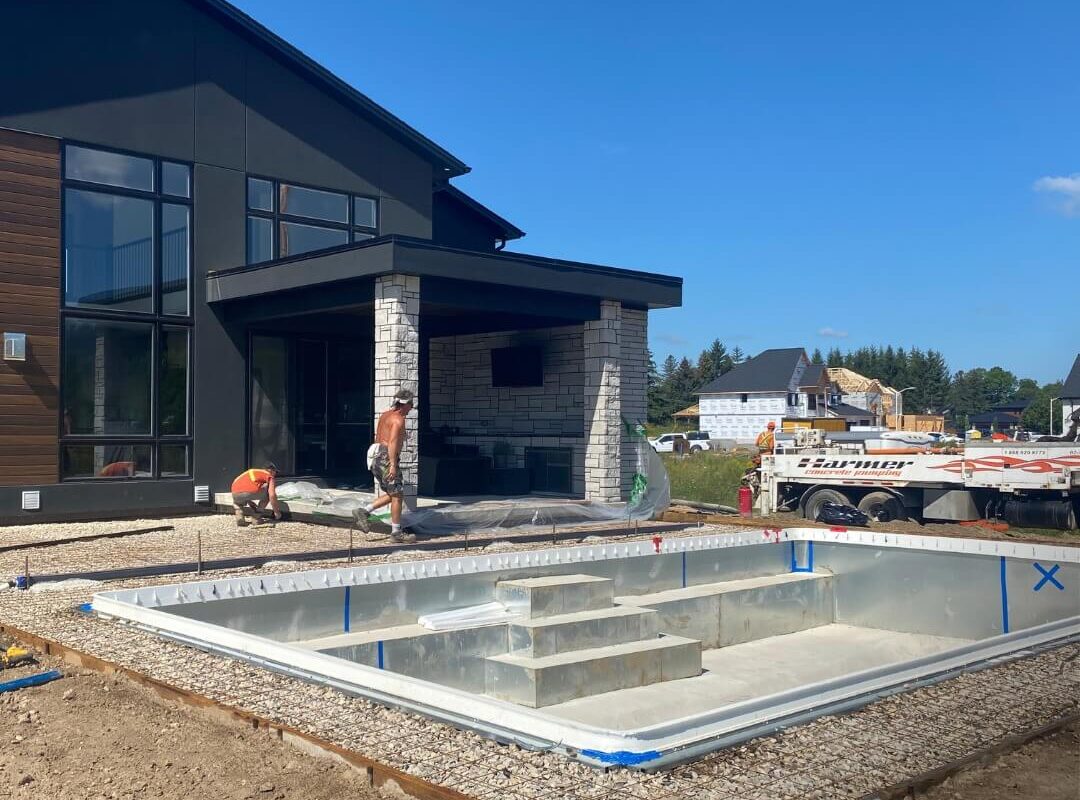
- Recommended: Broom, light sandblast, or decorative overlays that accept texture; if sealing for aesthetics, add grit to the sealer or broadcast grit then back-roll.
Avoid for exterior: Smooth steel-troweled finishes. They are the most slip-prone when wet/icy and can reduce surface air content if overworked.
3. Measure traction, don’t guess
There’s no single U.S. legal coefficient-of-friction number for concrete walkways, but there are accepted tests:
- ASTM E303-22 (Pendulum Test) measures wet dynamic COF on hard surfaces (including concrete). It’s widely used internationally and recognized in U.S. practice. Many agencies and safety bodies consider PTV ≥ 36 (wet) as “low slip potential.” Use the Pendulum to validate your finish/sealer combo in wet winter conditions.
Tip: Test representative panels after sealing (with and without grit) so owners can see the traction/appearance trade-off before full application.

4. Seal smart for winter: pick chemistry that keeps texture
De-icers (chlorides) and cyclic wetting drive surface scaling and rebar corrosion. The sealer you choose should protect without killing texture:
- Penetrating silane/siloxane (≈40% actives)
Forms a hydrophobic barrier inside the concrete, reducing water and chloride ingress without adding a slippery film. Extensively used on bridge decks and pavements; performance commonly validated with NCHRP 244 Series II/IV (absorption & chloride reduction) and ASTM C1585 (sorptivity).
- Film-forming acrylics/urethanes/epoxies
Enhance color and block water at the surface but can increase slipperiness when wet unless you add grit. If you must use a film for aesthetics, choose a matte formulation and include aluminum-oxide or polymer grit in the final coat (typ. manufacturer-guided dosages). - Spec note (bridges/parking): DOTs often look for silanes meeting NCHRP 244 reduction thresholds in water/chloride absorption; include that acceptance language if you want objective performance.
5. De-icers: what to use—and when
- First winter: Avoid de-icers altogether; use plain sand for traction. Early de-icer use is strongly linked to scaling of new slabs.
- Never use: Ammonium sulfate/nitrate—they chemically attack concrete.
- Use sparingly after year one: Sodium chloride (rock salt) is common but still contributes to scaling over time; protect surfaces with a penetrating sealer and rinse accumulations. Calcium and magnesium chlorides are effective at lower temps but are harsher to concrete—use with caution and good maintenance.
6. Drainage and layout matter as much as texture
Ice forms where water lingers. Give water a way out:
- Walkways (access routes): Keep cross-slope ≤ 1:48 (2%) per ADA while ensuring positive drainage; avoid flat pads that pond.
- Parking/vehicular slabs: Design for reliable runoff; many guides recommend ~2–5% slope for paved surfaces depending on the area.
Proper slope and finish matter whether you’re planning concrete decks, driveways, and patios in London, Ontario
7. Quick selection matrix
| Area | Best-bet finish | Sealer strategy | Traction validation |
| Sidewalks/entries | Medium broom (perpendicular to travel) | 40% silane/siloxane penetrating repellent | ASTM E303 PTV ≥ 36 wet (sample panel) |
| Ramps/steep drives | Coarse broom or light tining | Penetrating silane; avoid films | E303 on-site with grade accounted |
| Decorative/stamped | Non-slip texture skins; avoid smooth | If film desired, add grit; otherwise penetrating silane | E303 before/after sealing with grit |
| Pool decks | Light broom/sandblast/overlay | Film with grit or penetrating | E303 wet validation |
8. Maintenance plan (what you tell the owner)
- Reseal cycle: Penetrating silanes lose effectiveness over years due to UV/abrasion; plan periodic re-applications per traffic and testing.
- Winter ops: Use sand as the primary traction aid; rinse heavy salt residues during thaws; promptly remove snow to minimize freeze–thaw cycling on the surface.
- Monitor traction: Re-test pendulum values in high-traffic zones after sealing or after two winters; refresh grit-enhanced film coats where numbers fall.
Key takeaways
- Texture first: Medium broom (or coarser for ramps) remains the most reliable, cost-effective winter finish.
- Protect without polishing: Prefer penetrating silane to keep texture and fight chlorides; if you need a film for aesthetics, add grit
- Validate with a test: Use ASTM E303-22 pendulum; aim for PTV ≥ 36 (wet) on sample panels.
- Mind the first winter: No de-icers; sand only.
Ready to upgrade your concrete before winter hits? At Brosco Concrete, we specialize in durable, slip-resistant finishes for driveways, patios, walkways, and commercial projects across London, Ontario.
Whether you’re looking for a functional broom finish, a stylish stamped design, or a custom solution built for heavy use, our team delivers quality that lasts through every season.
Get your free concrete quote today and make sure your surfaces are safe, durable, and winter-ready.